
Physical AI + Robotics

Physical AI and robotics engineering for industrial teams

A founder-led engineering engagement for manufacturers, logistics teams, and robotics OEMs. Build vision, simulation, and edge inference into a workflow your operators can test, supervise, and own.

Let's talk robotics
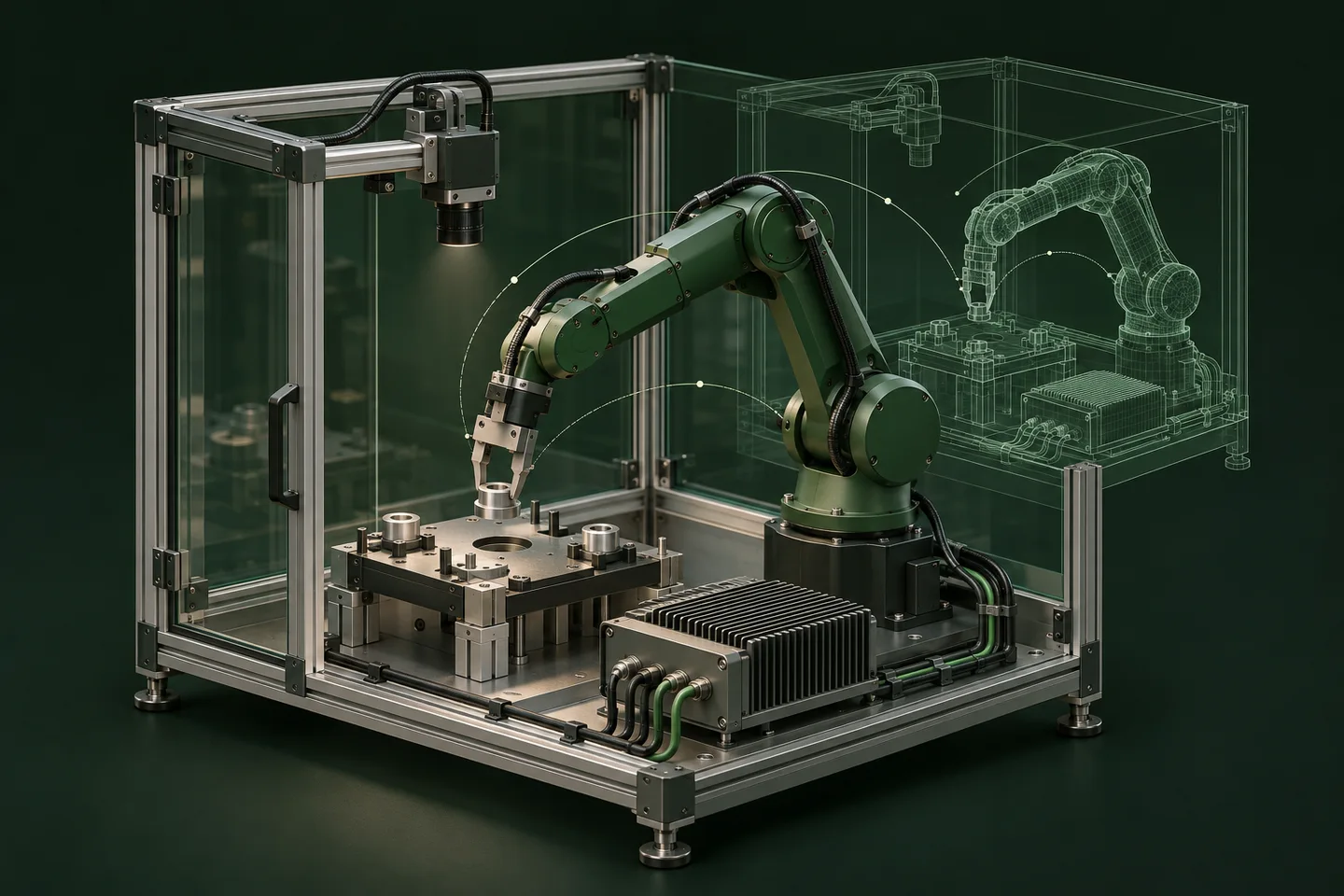
An industrial robot arm, inspection camera and edge computer beside a wireframe simulation of the same workcell.

Sense

Capture camera and sensor data at the station.

Concept illustration of a vision-guided workcell and its simulation twin.

Start with one station and a paid feasibility sprint

Choose a task with a baseline

Start with defect inspection on one product line, or a repeatable pick from a known fixture. Bring sample parts, existing cycle time and error rates, camera footage or CAD, the robot and controller model, and an operations owner.

Prove the task before it controls the line

Test representative failures and compare with the existing process. For inspection, start in shadow mode with operator review. For motion, rehearse in simulation or on a bench before supervised cell trials with the site integrator.

Agree on the rollout gate

Agree on false accepts and rejects for inspection, or pick success and interventions for handling. Measure cycle time, tail latency and recovery on the target hardware. Deliver a results report, integration plan, bill of materials, and a go or no-go decision.

Prepare for multiple sites

For an enterprise rollout, add versioned models and configuration, site acceptance tests, change control, network and data review, deployment rollback, operator training, and clear ownership for ongoing support.

Build on NVIDIA where the workload justifies it

Simulate with Isaac Sim and Omniverse

Build a workcell from robot geometry and site assets, model cameras and objects, and vary lighting and poses. Use Isaac Lab for imitation or reinforcement learning when the task needs a learned policy.

Choose a model for the task

Start with a detector, segmenter, or anomaly model for bounded inspection. Evaluate Cosmos 3 Super for synthetic scenarios, Nano for post-training workflows, or Edge for on-device visual reasoning. Evaluate Isaac GR00T for humanoid or dexterous policies where the robot, demonstration data, and model license fit.

Size training and edge compute separately

Use RTX workstations or cloud GPUs for simulation and training. Benchmark Orin Nano or Orin NX for compact perception, AGX Orin for more memory or cameras, and AGX Thor for demanding multi-sensor or larger model workloads. Select production hardware after measuring memory, power, thermals, latency, and camera interfaces.

Integrate with the controls already on site

Use JetPack, TensorRT and Isaac ROS where they fit. Keep robot, sensor and telemetry interfaces documented. The robot controller and site-approved safety system retain motion limits, interlocks and stop authority.

Choose the simplest platform that clears the test

Fixed inspection or machine tending

Benchmark a conventional camera or vendor-native cobot cell first. A predictable task with fixed fixtures may be commissioned faster by a local integrator using familiar tooling.

Portable robotics software

Use ROS 2 with Gazebo and MoveIt 2 when open interfaces and compatibility across robots matter most. Compare sensor fidelity and driver support on the actual robot before choosing the simulator.

Low-cost manipulation research

Use Hugging Face LeRobot with a supported bench arm to collect demonstrations and test imitation learning before committing to an industrial robot. Treat the bench as a learning environment and validate again on the customer’s hardware.

NVIDIA simulation and edge deployment

Choose this path when GPU simulation, synthetic data, accelerated perception, or heavier edge models address a measured constraint. Keep a conventional baseline to show what the extra complexity buys.

Engineering experience behind the practice

  • Carbon + Zig robotics engines

    ImadDhin Labs research on deterministic control loops, sensor integration, and ROS 2 interoperability.

  • RiseRight

    Mobile AI scanning that turns photos and screenshots into structured schedules. Relevant experience in capture, extraction, and integrating model output into a user workflow.

  • FoCoCo

    Shipped AI coaching software with voice and GPS workflows. Relevant experience in production AI, telemetry context, and mobile delivery.

How industrial teams started

  • GXO and Agility Robotics

    A late-2023 pilot focused on transferring totes to conveyors. It led to a commercial agreement in 2024, followed by a multi-site expansion agreement in 2026.

  • Craft and Technik Industries

    A conventional cobot cell combined CNC tending and automated inspection. The case is a useful baseline for a factory that already knows the task it wants to automate.

  • BMW factory logistics

    BMW used NVIDIA simulation to plan factories and train robots for material flow. Simulation earns its place when it helps test changes before they reach the floor.

Platform documentation

Questions before a pilot

Bring one task from your floor.

Share the station, the hardware you already use, and what a successful cycle looks like. We’ll use the first call to scope a pilot your operations team can evaluate.

Let's talk robotics