

Vibe-Code Rescue & Production Hardening
Vibe code rescue.
Fix and launch your AI-built app.
Your Lovable, v0, Cursor, Replit or FlutterFlow build is stuck. Review the blockers in authentication, payments and data access and agree a scoped plan to launch with tests, ownership and a clear handover.
The missing half of vibe coding
Build something people can trust. And actually want.
AI makes a first version easier to build. Engineering makes it dependable. Customer learning tells you whether it deserves to grow. Work on all three from the beginning.
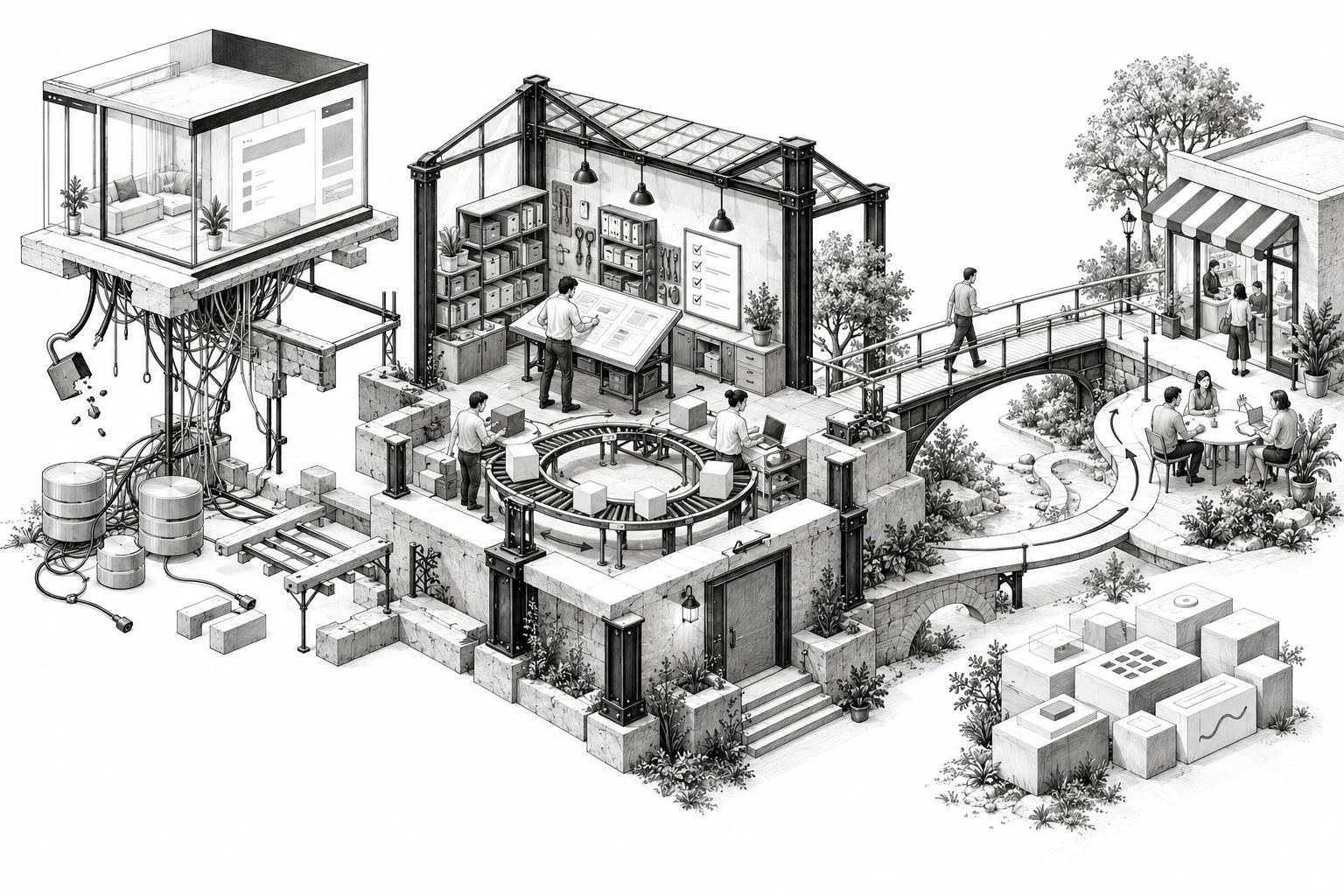
01 / The convincing prototype
A finished interface can hide missing foundations, unsafe access and untested assumptions.
02 / The engineering discipline
Understand the system. Give agents useful context. Review, test and release small changes.
03 / The customer reality
Find a specific buyer, prove a useful outcome and learn why people return—or leave.
Understand → scope → build → test → review → release
Listen → position → reach → activate → retain → learn
Run both loops together. A successful build is evidence of delivery; repeat customer use is evidence of value.
Explore the seven gaps
Customers & distribution
A product can work perfectly and still have no market.
What gets missed
Adding features is visible progress. Learning who will buy, why they switch and how to reach them is easier to postpone—especially when building feels almost free.
A better practice
- Choose one buyer and one costly or frequent problem. Ask about the last time it happened, the workaround and the buying decision.
- Test a clear offer with a working demo and a reachable audience. Ask for a meaningful next step: a pilot, a purchase or a real workflow trial.
- Track acquisition source, activation, repeat use and paid retention. Fix the weakest step before adding features or increasing spend.
What to show before moving on
Customer behavior and a repeatable route to qualified buyers. Signups, followers and launch-day traffic alone do not prove demand.
From infrastructure to the person using it
The system behind a single click.
Follow a booking through the product: the customer chooses a time, the backend checks access and availability, the database saves the reservation, and the interface returns a confirmation. Every layer has a job.
01
Infrastructure keeps it available
Compute runs the services. Storage preserves the records. Backups and monitoring help the team detect failures and recover.
02
The backend protects the transaction
Check identity and permissions, validate the request, and reserve the slot without double-booking. A screen cannot enforce these rules on its own.
03
The frontend makes state understandable
Show availability, loading, errors and the result returned by the server. A booking is confirmed only after the save succeeds.
04
The customer gets a useful outcome
The person completes a real task. Their feedback and return use inform the next improvement, alongside the system’s operational signals.
An illustrated workflow, not a live system monitor. The request travels toward the backend; confirmation returns to the customer.
Download animated SVG
The part you cannot postpone
Your next milestone might be a customer. Not a feature.
In a crowded market, a longer feature list is a weak reason to switch. Position around one valuable outcome, meet buyers where they already look for help, and use their behavior to choose the next build.
01
Find a narrow starting market
Talk to a small set of reachable buyers. Record recent problems, existing alternatives, urgency and who approves spending. Turn their language into a specific promise.
TrackQualified conversations, repeated problems and willingness to commit to a trial or paid pilot.
DecideIf the pain is vague or switching is not worth it, refine the audience or offer before expanding the build.
02
Test one distribution route
Choose the route that fits the buyer: useful niche content and search, relevant communities, thoughtful direct outreach, or a trusted partner. Use one focused landing page and demo.
TrackQualified visits or conversations → trial starts, by source. Track time and spend as well as clicks.
DecideIf the audience is wrong, change targeting. If the right people arrive but do not try, test the promise, proof or next step.
03
Make the first useful result easy
Help trial users complete one meaningful job. Observe the session, remove setup friction and offer hands-on onboarding while the product is young.
TrackShare of trial users reaching the core outcome and time to that result. Separate cohorts by acquisition source.
DecideIf people sign up but never get value, fix the journey before sending more traffic into it.
04
Earn return use before scaling spend
Ask why users return, leave or decline to pay. Improve the outcome they value. Test pricing and referrals, then expand a channel when retention and delivery economics support it.
TrackReturn use at the product’s natural cadence, paid conversion, cancellations and contribution after service/API costs.
DecideIf new acquisition only replaces departing customers, investigate value and retention before increasing the budget.
There is no universal conversion target or guaranteed growth channel. Set a baseline for your product, choose one measurable experiment and review the result each week. Keep security and essential reliability in place throughout.
Start the next agent session with a better brief.
Use this with your existing tool. Fill in facts, link the relevant files and ask the agent to identify missing context before it changes anything.
CUSTOMER & OUTCOME
Who is this for? What real problem are we testing?

CURRENT SYSTEM
Repository, relevant files, installed versions, data flow, current behavior.

EVIDENCE
Reproduction steps, expected vs observed behavior, sanitized logs, official docs.

SCOPE & BOUNDARIES
One change. Files allowed. Data/access rules. What must stay unchanged?

DONE WHEN
Observable behavior, meaningful tests, deployed checks if in scope.

WORK LOOP
Inspect → plan → implement → test → review. Record results.
Set an attempt/time budget. Stop on repeated failure or missing authorization.

CUSTOMER LEARNING
What customer behavior will tell us this change matters? How will we measure it?
Where ImadDhin comes in
Keep your progress. Add engineering judgment.
Bring the product you have already built with Claude Code, Codex, Cursor, Replit, Lovable or another AI tool. I review the implementation and the customer journey, identify the highest-risk gaps, and scope the work needed to launch and learn with confidence.
- Claude Code
- Codex
- Cursor
- Replit
- Lovable
- Your existing stack
01
Review what exists
Map the architecture, reproduce key journeys and prioritize security, data and reliability findings with evidence.
02
Repair the critical path
Agree on a focused sprint. Fix the fragile parts, add regression checks and document what stays, changes or needs a rebuild.
03
Release with a learning plan
Define activation events, a useful onboarding journey and a customer experiment. Connect engineering priorities to what users actually need.
Bring a product link, the main blocker and who you want to serve. Scope and pricing follow the review. Customer acquisition and revenue are not guaranteed.
Interactive security lab
A working demo can hide a broken trust boundary.
Choose a risk, trigger a synthetic event, then apply safeguards and replay it. See why payments, data and permissions need independent checks.
The numbers behind the pitch
This isn't a hunch. It's measured.
Founders don't fail because the idea was bad — they fail because the build collapses the week it gets traction. Independent studies in 2025 put hard numbers on exactly where AI-built code breaks.
~45%
of AI-generated code introduced an OWASP Top 10 vulnerability
Veracode, 2025 (100+ models tested)
86%
of relevant samples failed to defend against cross-site scripting
Veracode, 2025
Unchanged
security stayed flat across 100+ models — bigger, newer models did not write safer code
Veracode, 2025
How much more often AI code breaks
Issues in AI-written code vs human-written code, by category. Anything past the dashed line is worse than a human would ship.
Source: CodeRabbit, “State of AI vs Human Code Generation” (Dec 2025, 470 real PRs)
Share of AI code that failed security tests
Percentage of samples that introduced an OWASP Top 10 flaw, by language. The dashed line is the all-code average.
Source: Veracode, 2025 GenAI Code Security Report (100+ models tested)
And it isn't getting fixed on its own. Across 100+ models of every size and vintage, Veracode found security performance stayed flat — newer, larger models write more functional code, not safer code. The judgment that keeps an app from leaking data on day one still has to come from an engineer.
The signature diagnostic
The 10-Point Production-Readiness Audit
Each domain has what I check — and what typically breaks in vibe-coded apps. You get a severity-ranked report with a Production-Readiness Score, evidence per finding, and a prioritized fix plan.
- 01
Auth & access control
Breaks: Missing checks on protected routes; users able to act as other users.
- 02
Row-level security & data access
Breaks: Tables left world-readable/writable; RLS never enabled — the #1 vibe-coded data leak.
- 03
Secrets & config
Breaks: API keys exposed in the client bundle or extractable from the compiled app.
- 04
Payments & webhooks
Breaks: Unverified webhook signatures, no idempotency, race conditions — fake “paid” events and double charges.
- 05
Input validation & error handling
Breaks: Malformed input, empty states, and failures crash the app or corrupt data.
- 06
Concurrency & scale
Breaks: N+1 queries, missing indexes, no rate limiting — slows to a crawl or falls over.
- 07
Security (OWASP Top 10)
Breaks: Injection, XSS, broken access control, insecure dependencies.
- 08
AI surface (OWASP LLM Top 10)
Breaks: Prompt injection, data exfiltration, unbounded model cost — jailbreaks and runaway bills.
- 09
Observability
Breaks: No logging, error tracking, or alerts — you hear it's down from a user, not a dashboard.
- 10
Architecture & build health
Breaks: The vibe-cycle tangle — no one can change anything without breaking something else.
From audit to production-grade
Start with an assessment and a practical fix plan. The audit fee is credited toward your rescue if you proceed.
01
Production-Readiness Audit
Full 10-point diagnostic + written report with severity-ranked findings and a fix plan.
- Evidence-backed findings
- Severity-ranked repair plan
- Written report and review
02
Rescue Sprint
Fix the criticals — auth, payments, security, the show-stoppers.
- Agreed launch blockers repaired
- Critical-path regression checks
- Deployment and change notes
03
Full Hardening
Re-architect the fragile core; add scaling, tests, and observability. Production-grade.
- Core architecture and access review
- Tests, monitoring and failure recovery
- Release checklist and runbook
04
Full Care Automation Agent
A fixed-scope automation agent: connect one agreed workflow, define permissions and approvals, then test, deploy and hand over.
- One agreed workflow and integrations
- Human approvals and execution limits
- Evaluation, deployment and handover
One-time price in USD. Scope and access agreed before work begins. Platform and API usage costs are separate.
Common questions
Can't I just ask the AI to fix it?
That's the vibe cycle — each fix introduces a new bug because nothing reviews the whole system. Production needs judgment the model doesn't have.
Isn't it cheaper to rebuild?
Usually not. The audit shows exactly what's salvageable, so you fix what's fragile and keep what works — far cheaper than a rewrite.
Will you lock me into your stack?
No. You keep full ownership of your code and your tools. I make your stack production-grade.
How do I know it's actually broken?
The assessment tests agreed flows and records evidence. The initial call scopes that work; it is not a live penetration test.
Get it audited before you scale
If you vibe-coded something and you're about to launch, start with a fixed-price Production-Readiness Audit. It's credited toward your rescue. The first call helps us agree on the scope and access needed for an evidence-based review.